| ? |
|
? |
| ? |
| ? |
|
? |
| ? |
| ? |
Ovarian Cyst :
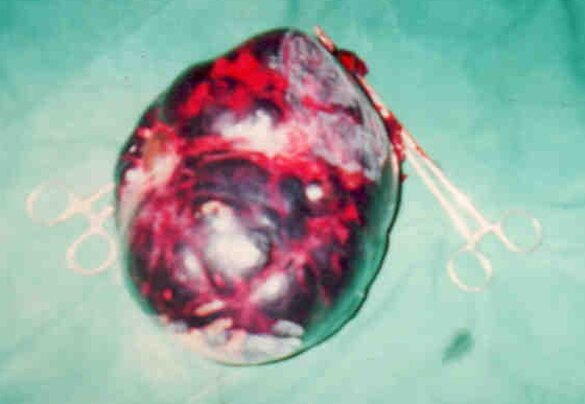
There are two ovaries, one at the end of each Fallopian tube or oviduct on either side of the womb. The function of the ovaries is to produce hormones, and an egg each month. Over 12 months each ovary will probably produce six eggs but not necessarily alternately. However, if one ovary is removed, the remaining ovary is capable of ovulating each month. This makes no difference to the menstrual cycle. Following each period, a little cyst starts to grow in one ovary: this contains the egg. It continues to grow for the first 2 weeks of the cycle and when it reaches about 2 cm across, it bursts and releases the egg. This cyst is called the follicle and makes the hormone oestrogen. The cyst changes to a more solid structure in the second half of the cycle. It is then called a corpus luteum and makes the hormones, oestrogen and progesterone. Ovarian cysts can therefore be normal: every woman in each monthly cycle makes a small cyst. However, any cyst which does not go away or is bigger than 5 cm may be abnormal. Cysts may cause pain which is usually dull and not severe. There may be quite severe pain on intercourse. If the cyst produces hormones it can cause abnormal bleeding. A cyst may become as large as a full term pregnancy: it will then cause swelling and may press on the bladder and bowel. Occasionally a cyst may block the bladder and stop the passage of urine. It may be silent and just found at a routine examination. Sometimes acute problems can arise in an ovarian cyst. It can twist round on itself causing gangrene in the ovary. This is acutely painful and is treated as an emergency. Occasionally a blood vessel may burst inside a cyst causing acute pain, or a cyst may rupture into the abdominal cavity. Both are emergency situations. Certain ovarian cysts may be malignant. This is more likely in women over the age of 40 or where the cyst contains areas of solid tissue instead of just fluid. Sometimes, both ovaries develop multiple small cysts at quite an early age. These are called polycystic ovaries.
|
| ? |
Why do Ovarian Cysts Occur :
Women being treated with fertility drugs are more likely to develop cysts. Endometriosis may also cause ovarian cysts. Otherwise little is known about their actual cause.
|
|
? |
| ? |
| ? |
Back
|
? |
| ? |
|
| Our Profile |
|
| Dr. Rajendra R. Jadhav |
 |
|
M.B.B.S., M.S.
(General Surgeon) KEM HOSPITAL PUNE. |
|
 ? ?
|
|
 |
| ? |
| Dr. Madhuri R. Jadhav |
 |
|
| M.B.B.S., C.G.O. |
|
|
?
|
|
|
| ? |
| Dr. Sushant R. Jadhav |
 |
|
M.B.B.S. (Mumbai), D.N.B.
(Orthopedic Surgeon) DEEN DAYAL HOSPITAL, NEW DELHI. |
|
|
?
|
| ? |
|
| ? |
| ? |
| ? |
|