| ? |
| Carcinoma Of Large Intestine |
|
? |
| ? |
| ? |
|
? |
| ? |
| ? |
Carcinoma Of Large Intestine :
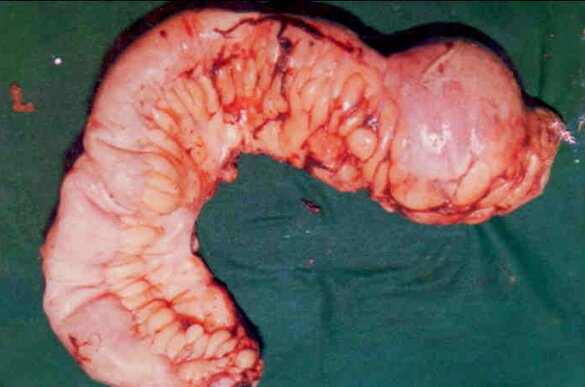
Almost all cancers of the large intestine and rectum (colorectal) are adenocarcinomas, which develop from the lining of the large intestine (colon) and rectum. Colorectal cancer usually begins as a buttonlike swelling on the surface of the intestinal or rectal lining or on a polyp. As the cancer grows, it begins to invade the wall of the intestine or rectum. Nearby lymph nodes also may be invaded. Because blood from the wall of the intestine and much of the rectum is carried to the liver, colorectal cancer usually spreads (metastasizes) to the liver soon after spreading to nearby lymph nodes.
|
| ? |
Risk Factors :
1) People with a family history of colorectal cancer have a higher risk of developing the cancer themselves. A family history of polyps (see Tumors of the Digestive System: Colorectal Polyps) also increases the risk of colorectal cancer.
2) People with ulcerative colitis or Crohn's disease are at greater risk as well. This risk is related to the person's age when the disease developed and the length of time the person has had the disease.
3) People at highest risk tend to consume a high-fat, low-fiber diet. Greater exposure to air and water pollution, particularly to industrial cancer-causing substances (carcinogens), may play a role.
|
| ? |
Prognosis and Treatment :
Colon cancer is most likely to be cured if it is removed early, before it has spread. Cancers that have grown deeply or through the wall of the colon have often spread, even if metastases (spread) cannot be detected. Surgery, the main treatment for colorectal cancer, cures about 90% of cases when the cancer is only in the lining of the bowel wall, about 70% of cases when the cancer extends through the bowel wall, and only about 30 to 50% of cases when the cancer has spread to the lymph nodes in the abdomen. In most cases of colon cancer, the cancerous segment of the intestine and any nearby lymph nodes are removed surgically, and the remaining ends of the intestine are joined. For rectal cancer, the type of peration depends on how far the cancer is located from the anus and how deeply it has grown into the rectal wall. The complete removal of the rectum and anus leaves the person with a permanent colostomy, which is a surgically created opening between the large intestine and the abdominal wall. The contents of the large intestine empty through the abdominal wall into a colostomy bag. If possible, however, only part of the rectum is removed, leaving a rectal stump and the anus intact. Then the rectal stump is rejoined to the end of the large intestine.
|
|
? |
| ? |
| ? |
Back
|
? |
| ? |
|
| Our Profile |
|
| Dr. Rajendra R. Jadhav |
 |
|
M.B.B.S., M.S.
(General Surgeon) KEM HOSPITAL PUNE. |
|
 ? ?
|
|
 |
| ? |
| Dr. Madhuri R. Jadhav |
 |
|
| M.B.B.S., C.G.O. |
|
|
?
|
|
|
| ? |
| Dr. Sushant R. Jadhav |
 |
|
M.B.B.S. (Mumbai), D.N.B.
(Orthopedic Surgeon) DEEN DAYAL HOSPITAL, NEW DELHI. |
|
|
?
|
| ? |
|
| ? |
| ? |
| ? |
|