| ? |
|
? |
| ? |
| ? |
|
? |
| ? |
| ? |
Uterine Fibroid :
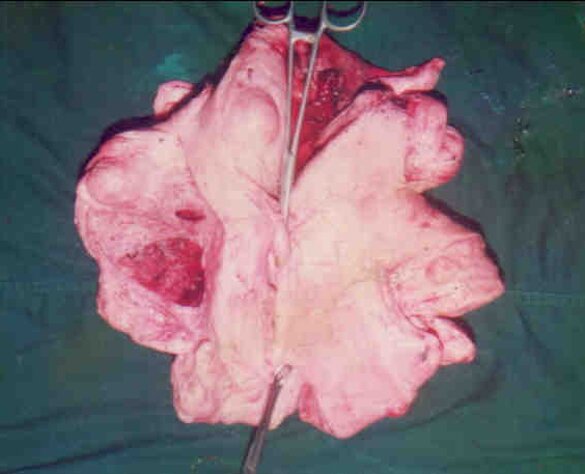
Uterine fibroids (singular Uterine Fibroma) (leiomyomata, singular leiomyoma) are benign tumors which grow from the muscle layers of the uterus. They are the most common benign neoplasm in females, and may affect about 25% of white and 50% of black women during the reproductive years. Uterine fibroids often do not require treatment, but when they are problematic, they may be treated surgically or with medication ?— possible interventions include a hysterectomy, hormonal therapy, a myomectomy, or uterine artery embolization. Uterine fibroids shrink dramatically in size after a woman passes through menopause.
Fibroids are named according to where they are found. There are four types: Intramural fibroids are found in the wall of the womb and are the most common type of fibroids found in women. Subserosal fibroids are found growing outside the wall of the womb and can become very large. They can also grow on stalks (called pedunculated fibroids). Submucosal fibroids are found in the muscle beneath the inner lining of the womb wall. Cervical fibroids are found in the wall of the cervix (neck of the womb). In very rare cases, malignant (cancerous) growths on the smooth muscles inside the womb can develop, called leiomyosarcoma of the womb.
|
| ? |
Treatment :
The presence of fibroids does not mean that they need to be treated; it is expectantly depending on the symptomatology and presence of related conditions. The presence of uterine fibroids can cause problems which can be solved by:
* Surgery: Surgical removal of a uterine fibroid usually takes place via hysterectomy, in which the entire uterus is removed, or myomectomy, in which only the fibroid is removed.
* Uterine artery embolization (UAE): Using interventional radiology techniques, the Interventional Radiologist occludes both uterine arteries, thus reducing blood supply to the fibroid.
* Medical therapy: First line treatment may involve oral contraceptive pills, either combination pills or progestin-only, in an effort to manage symptoms. If unsuccessful, further medical therapy involves the use of medication to reduce estrogens in an attempt to create a medical menopause-like situation.
* HIFU (High intensity focused ultrasound), also called Magnetic Resonance guided Focused Ultrasound, is a non-invasive intervention (requiring no incision) that uses high intensity focused ultrasound waves to ablate (destroy) tissue in combination with Magnetic Resonance Imaging (MRI), which guides and monitors the treatment. This technique is relatively new; it was approved by the FDA in 2004.
|
|
? |
| ? |
| ? |
Back
|
? |
| ? |
|
| Our Profile |
|
| Dr. Rajendra R. Jadhav |
 |
|
M.B.B.S., M.S.
(General Surgeon) KEM HOSPITAL PUNE. |
|
 ? ?
|
|
 |
| ? |
| Dr. Madhuri R. Jadhav |
 |
|
| M.B.B.S., C.G.O. |
|
|
?
|
|
|
| ? |
| Dr. Sushant R. Jadhav |
 |
|
M.B.B.S. (Mumbai), D.N.B.
(Orthopedic Surgeon) DEEN DAYAL HOSPITAL, NEW DELHI. |
|
|
?
|
| ? |
|
| ? |
| ? |
| ? |
|