| ? |
|
? |
| ? |
| ? |
|
? |
| ? |
| ? |
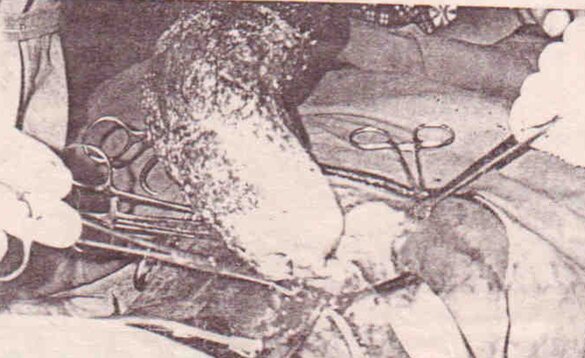
Trichobezoar :
A bezoar or enterolith is a sort of calculus or concretion, a stone found in the intestines of mostly ruminant animals, but occurring among others including humans. There are several varieties of bezoar, some of which have inorganic constituents and others organic.
|
| ? |
History :
Bezoars were formerly sought after because they were believed to have the power of a universal antidote against any poison. It was believed that a drinking glass which contained a bezoar set within would neutralize any poison poured into the glass. The word "bezoar" ultimately comes from the Persian pâdzahr (??????), which literally means "protection from poison." In fact, some types of trichobezoar are apparently able to precipitate or bind arsenic compounds (long used as poison) from a solution. [citation needed] In 1575, the surgeon Ambroise Paré described an experiment to test the properties of the Bezoar Stone. At the time, the Bezoar stone was deemed to be able to cure the effects of any poison, but Paré believed this was impossible. It happened that a cook at Paré's court was caught stealing fine silver cutlery. In his shame, the cook agreed to be poisoned. He then used the Bezoar stone to no great avail as he died in agony seven hours later.[1] Paré had proved that the Bezoar stone could not cure all poisons as was commonly believed at the time. A famous case in the common law of England (Chandelor v. Lopus, 79 Eng Rep. 3, Cro. Jac. 4, Eng. Ct. Exch. 1603) announced the rule of caveat emptor, "let the buyer beware" if the goods he purchased are in fact genuine and effective. The case concerned a purchaser who sued for the return of the purchase price of an allegedly fraudulent bezoar. (How the plaintiff discovered that the bezoar did not work is not discussed in the report.) Judicial scepticism over the alleged magical powers of bezoars may well have justified this judgment in this particular case. The ruling, however, was seized on and formed an impediment to the formation of effective consumer protection remedies and the law of implied warranty well into the nineteenth century.
|
| ? |
Types of bezoars :
* Food boli (singular, bolus) imitate true bezoars and are composed of loose aggregates of food items such as seeds, fruit pith, or pits as well as other types of items such as shellac, bubble gum, soil, and concretions of some medications.
* Pharmacobezoars (or medication bezoars) are mostly tablets or semi-liquid masses of drugs.
* Phytobezoars are composed of nondigestible food material (e.g., cellulose) and are frequently reported in patients with impaired digestion and decreased gastric motility.
* Trichobezoar is a bezoar formed from hair - an extreme form of hairball. Humans who frequently consume hair sometimes require these to be removed. This has also been called Rapunzel syndrome. A trichobezoar in the trachea is called a tracheobezoar.
* Diospyrobezoar is a bezoar formed from persimmons. This type of bezoar is usually seen in humans who have had prior gastric surgery or ailments. These may respond to treatment by dissolution or in some cases surgery.
|
|
? |
| ? |
| ? |
Back
|
? |
| ? |
|
| Our Profile |
|
| Dr. Rajendra R. Jadhav |
 |
|
M.B.B.S., M.S.
(General Surgeon) KEM HOSPITAL PUNE. |
|
 ? ?
|
|
 |
| ? |
| Dr. Madhuri R. Jadhav |
 |
|
| M.B.B.S., C.G.O. |
|
|
?
|
|
|
| ? |
| Dr. Sushant R. Jadhav |
 |
|
M.B.B.S. (Mumbai), D.N.B.
(Orthopedic Surgeon) DEEN DAYAL HOSPITAL, NEW DELHI. |
|
|
?
|
| ? |
|
| ? |
| ? |
| ? |
|